Saturday, July 26, 2007 Aberystwyth and The National Library of Wales (Llyfrgell Genedlaethol Cymru)


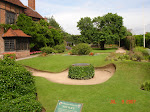
Graeme dropped me off in town and I took the train from Tywyn to Machynlleth and from there to Aberystwyth to see the National Library of Wales, which sits high atop a hill overlooking the city and the ocean beyond. I went in and got a reader's card and took a tour of some of the library's displays, one of which was a video production on binding books by hand. I stood and watched it with interest, and was interested to see that it had been created by the British Library. The film just increased my interest in preservation and conservation and archiving. This year was the National Library's centenial, as reflected by the floral tribute above.
The library houses the National Screen and Sound Archives and hosts a number of spectacular exhibits, including one on photographer Geoff Charles's work and a John Donne and Robert Owen exhibit as well. The library is in the process of digitizing much of the Geoff Charles collection at this time.
The library is a legal deposit library and it holds the world's largest collection on Wales and other Celtic nations. I found it interesting that the National Library of Wales has also begun a partnership with the state of Ohio to gather and preserve information about Welsh Americans.
The Welsh National Library handles reader requests much like the British Library in London does, but on a somewhat smaller scale. There was only one young lady taking care of reader registration when I went in to get my card. Once I had my card, I was free to request and read any items of interest found in their collection.
The website for the library is http://www.llgc.org.uk/. An interesting fact that I learned while there was that there had been a huge argument between Aberystwyth and Cardiff about which City should be allowed to have the National Library locate there. In the end, Aberystwyth won the library, and Cardiff got the National Museum Wales, which is also celebrating its centenary this year. http://www.museumwales.ac.uk/en/home/
The National Library collection holds several items by and about Susan Cooper, but unfortunately I did not have enough time to request and view them and to make the last train back to Tywyn via Machynlleth. The trip was worthwhile anyhow because I did get the opportunity to take a brief tour of the building and to see some of the exhibits. I also found it interesting that the Univeristy of Wales, Aberystwyth offers an information studies postgraduate degree, including a doctoral program. I'll file that information away for future reference.

Saturday evening I was able to get on a special excursion of the local steam train line, Tal y Llyn Railway up past my hotel at Dolgoch Falls and on the Abergynolwyn and then back down to the hotel. On the trip up to Abergynolwyn and back down to Dolgoch Falls, I had a lot of fun listening to the people in my coach talk about their experiences as Tal y Llyn railway volunteers over the past several years. They swapped stories and laughed about jokes they'd played on each other and were quite happy to include me in the fun as they reminisced.

I spent the rest of the evening in the pub talking with Sarah, the local historian. We discussed the background of Susan Cooper’s books and how she used Tywyn as the setting. No one there had read the books, but Ron, an elderly gentleman who was spending the weekend and had heard me talking about Susan Cooper the previous night, found a paperback copy of The Dark is Rising and brought it around for everyone to see.

Dolgch Falls

Friday, July 25, 2007 Wales at Last!

I am finally getting the hang of this blog thing! It has been difficult to figure out how to add and correctly place pictures, video clips, and so on, but I think it is finally coming together, just in time for the best part of the whole British experience, Wales.


I took Arriva Trains from Manchester, England to Tywyn, Wales with several train changes along the way. Everything went smoothly, and the train trip was comfortable and uneventful. I knew that I was headed for an isolated area that was accessible by limited bus service, by car (which I wasn't brave enough to try), on foot, or by steam railway. I ended up using a combination to get around the area.

I arrived at Tywyn Station via Arriva Trains Wales on Friday afternoon, a cool, blustery, cloudy afternoon. The gray ocean lay to the east, and to the west was a magnificent valley that was bordered on the north by the distant mountains of Snowdonia and to the south by the Cambrian Mountain Range.


I felt the way I'm sure Will Stanton must have felt when he arrived at Tywyn in Susan Cooper's Grey King, a stranger in a strange land. The thing that made me feel a little like I was a foreigner was that all signs were posted in Welsh as well as English, and I was very glad that I had practiced saying many of the place names with the help of a Welsh friend from home because to the American eye, they looked totally unpronounceable and I was afraid that I would be unable to correctly enunciate the names of places that I wanted to go when asking for train tickets, etc. Will would probably have felt the same way, having been an English boy raised near London.


The Welsh language seems to be short on vowels, and favors lots of Y's. Welsh puts one in mind of the Germanic languages because of all the sharp consonants and sibilant sounds that are involved. The double L, which makes a sound that we don't use in English, was especially challenging. One must place the tip of the tongue lightly behind the teeth barely touching the roof of the mouth and blow out to create the sound of those two letters when they are found together in Welsh words.


Anyway, once off the train, I pulled my heavy suitcase down the northbound platform and across the tracks at the crossing and along the southbound platform next to the station and out to the car park area. Out on High Street, I strolled through the center of Tywn, found something to eat at a small diner, and located the Tourist Information Center. The lady who worked there gave me maps and brochures and we talked a little about the area. An elderly British bicyclist came in to get information on some local attractions and he told me that he had come to Tywyn on holiday years before and when his wife passed away last year, he had moved to Tywyn from California.


After leaving the tourist center, I began looking for the bus stop. In the process of walking on down High Street, I spotted beds and breakfasts, just as Will mentions seeing on his first trip through town with his grownup cousin Rees. In addition, there was a news agent's shop right across the street, perhaps the same one that Susan Cooper describes Will later entering to get stamps to send a card home to his family. Once I found the bus stop, I discovered that there was only one other bus out of town to Dolgoch Falls were I was staying, and it would arrive shortly.


When I got on the bus, I just sat and stared at the scenery. The narrow roads had thick, shrubby fence rows that grew to within inches of the road. Many of the fence rows grew on waist-high banks that one could reach out and touch from a vehicle window they were so close. It was clear that there were few road shoulders upon which a pedestrian might walk, so I had a better understanding of why hikers are permitted to pass through farm fields without being accused of trespassing. The only thing that farmers ask is that they don't make too much noise and that they close all farm gates as they pass through. Many farmers have build stiles right over the fences so they don't have to worry about anyone leaving gates open.


The view of the Fathew Valley that led up toward Tal y Llyn was beautiful, bordered on both sides with steep mountains dotted with white sheep, stone fences, heather, and shoulder-high fern. There were many farms along the way, any one of which might have been that of Will's uncle in the stories. When the bus did let me off at Dolgoch Falls Hotel, the place was quaint and charming.


After meeting Graeme and Allyson, the young couple who own Dolgoch Falls Hotel, and checking into my room, I took a walk up the valley for a short distance. It was beautiful! I was right about the roads; there were many places where the roads were closely edged by fence rows and I had to keep a careful watch for cars to keep from being hit. Since I knew I was going to be walking a lot, I realized I'd definitely have to use farm fields to get where I wanted to go.
When I got back from my walk further up the valley, I strolled up behind the hotel to Dolgoch Falls. As I climbed the mountain, I came to one waterfall after another. They were magnificent and the sound was almost deafening at times.
I had a lovely dinner of leek and potato soup with crusty rolls, chicken breast with whole grain mustard, and vegetables on the side, along with a nice cup of tea at the end. I was seated in the dining room at a small table with another guest eating at another small table nearby. We exchanged small talk as Graeme served our food, and not for the last time while there, I felt as though I was stepping straight out of an Agatha Christie novel. The only thing missing from the scene was a murder or two, and thankfully, that remained the case during my stay.

I spent the rest of the evening in the hotel’s tiny pub taking advantage of their wireless Internet service. It was quite enjoyable to sit and talk with the hosts and their guests as they had drinks and chatted. Two elderly gentlemen were discussing the unwelcome effects of computerization upon the train system and I couldn't help think that had it not been for computers and the railway system, Tywyn or Dolgoch Falls.


Thursday, July 24 Minibreak Begins With Sidetrip to Dublin

Libby, Edie, Nancy and I left Mary at Pollack Hall in Edinburgh and headed to the airport bright and early on Thursday morning to catch a RyanAir flight to Dublin. Libby and I checked into a hotel near the airport and then we all took a whirlwind tour of Dublin. One of the first landmarks that we spotted was the Millennium Spire or Dublin Spire, renamed "The Spike" by locals. It was rather awe-inspiring, especially up close. To read more about the spire, visit : http://irelandposters.com/dublin/dublin_city_spire_pictures.html

After a quick lunch in a Dublin pub, we found a hop-on, hop-off bus tour that would take us past popular tourist spots in Dublin, including Guinness Warehouse (we did not stop), the National Library and the National Museum, Trinity College, Christ Church Cathedral, St. Patrick's Cathedral, the National Gallery, and the Museum of Modern Art, among others. Unfortunately, we were pressed for time and too worn out at that point to actually get off the bus and visit the sites. I have to confess that I (among others) fell asleep on the tour and missed one or two of the landmarks. Actually, we would have needed several days in Dublin to see everything, but at least we did get a brief overview. Perhaps Dublin could be another London Away site visit for future British Studies/British Libraries and Archives classes.

In the late afternoon, Libby and I parted ways with Edie and Nancy and struck off on our own. We passed a movie theatre where Harry Potter and the Order of the Phoenix was showing and decided that seeing the movie in Dublin would be a fun way to remember our short visit there. Due to our exhausted state, there was a real danger that we might fall asleep once the lights dimmed, but we decided to take a chance. After Libby and I went inside, bought our tickets, and headed toward the entrance to the theatre where our movie was showing, Libby stopped me and pointed toward a poster for an upcoming movie feature. I was thrilled to see a movie poster for The Dark is Rising! I had already researched the movie, and knew that it departed quite a bit from Susan Cooper's original stories, but it was rather exciting to see the poster there in the theatre. For the movie trailer, visit http://www.seekthesigns.com/
We made an early evening of it and headed back to our hotel via bus. The highlight (for me) of the hotel was a very clean, spacious bathroom with a large elegant shower! In the wee hours of the morning of July 25, I took a taxi back to the airport and headed for Wales via Manchester, England, leaving Libby in Dublin to start her mini break plans. I cannot describe the excitement that I felt about beginning the next part of my adventure.

Wednesday, July 25, 2007 Edinburgh Writer's Museum


The Edinburgh Writer's Museum is located off the Royal Mile in Lady Stair's House. It features the lives and work of Scottish authors Robert Burns, Sir Walter Scott, and Robert Louis Stevenson. The museum offers self-guided tours and features photos, paintings, memorabilia, and other items related to the lives of these three famous Scots.
The author with whom I related most was Robert Louis Stevenson because I have always enjoyed the adventures that he wrote so well. It was interesting to see the photographs and other pieces of memorabilia related to his life and times, and to see pictures of his family, and to realize that he had spent quite a bit of time in the United States before his death. The collection consists of some very personal items belonging to the authors, and based on the displays, it seems that Burns was quite the lady's man. It was also interesting to note that Stevenson married a divorced woman with two children. That fact is rather reminiscent of C.S. Lewis, who also married a divorcee with two children. I suppose that fact was significant to me because of the way divorcees were looked down upon by society, especially during the late nineteenth century and early twentieth one.
One of the neat things about the place is the engraved cobblestones out in the courtyard that commemorate the lives of several Scottish authors, including some from modern times. The museum tour was free of charge, and proved to be quite interesting. I have an new appreciation for Stevenson, Burns and Scott.


Monday evening, July 23, 2007-A new job, maybe?

I had the most unique job interview ever! While still in London, I found an opening in Jefferson County, Kentucky and submitted an online application for the elementary library position that was being offered. The school principal got in touch with me to ask if I would be interested in interviewing via telephone from Scotland, and of course I was. At the appointed time, I called the school and was interviewed by the site based council. They took turns asking me questions, and when I asked questions, they took turns answering them as well. Their questions were to-the-point and showed that they had the same vision for a good library program as me, and when I asked questions of them, their answers satisfied my need to know that they were interested in collaborating. The principal was supportive in every way, and after the interview was over, I decided that I would probably take the position if it was offered, even though it would mean an immediate move once I got home from Britain.

Monday, July 23 National Library of Scotland and National Archives


During our first full day in Edinburgh, we visited both the National Library of Scotland and the National Archives. On Monday morning, we took a bus to the downtown area and then walked over to the National Library of Scotland where we were met by Emma Faragher and Senior Curator David McClay who talked about the library, its history, and its function.


The National Library of Scotland began in the 1690's as an advocate's library, or a legal library and it contained books and manuscripts. The library began to grow and evolve in 1710. It is now one of the top ten libraries in the world, based on size and usage. The library contains over 3,000,000 maps, gazetteers, atlases and so on. In addition to books, the collection contains music, all types of print publications, film archives, and electronic publications. Thousands of items are sent to the library each week from publishers, and since it is a "bibliographic" library, every item that is contributed is kept forever. The library's collection is valued anywhere from forty-five to seventy-five million British Pounds Sterling.
The library is trying to put on a more public and welcoming face and in order to do that, funding needs have change. The organization depends upon trust funds, heritage lottery funds, and government funds to keep the library running. Since the library uses public funds, it has to report how the money is being used to the Scottish Executive, which in turn, makes suggestions about how to spend the money. Some of the suggestions that have been made include spending more on services to under served populations and digitization of over 15,000 entities in the collection. The new vision for the library requires added funding, so there are now four library staff who work on fundraising. McClay credits the example of "the Americans" as their inspiration because they have looked to American fundraising methods to help the library move forward. The library staff is said to be very excited about the change in focus over the past several years.
David McClay talked at length about the John Murray Archive, how it was acquired, and how it is being displayed. It is very evident that the library staff is very proud of the John Murray Archive and that the three years that have been invested in the project and ended with a positive result.
The goal of the library is to be more open and accessible, and the John Murray Archive is just one way of accomplishing that goal, not only for serious researchers, but also for the ordinary man off the street.
I found the library to be open and welcoming. The presentation was informative and interesting, and the people were very hospitable. They won us over right away by serving tea and refreshments midway through the program. When we went into the John Murray Archive, I found it to be imaginative, attractive, engaging, and informative. The brochures and marketing materials were attractive and well designed, and the colorful banners hung on the front of the library building all worked together to make the library a more welcoming place.
When we visited the National Archive of Scotland in the afternoon, I was immediately impressed by the security. We were buzzed through locked doors and taken to a large room that had security locks that were set once we were all inside and seated. Margaret MacBryde, the Education Officer told us that the aim of the archive is to provide access and outreach to all ages. She also told us that the archive is made up of three buildings which include the General Register House, St. George's Church, and the Thomas Thompson House. The archive is funded by the central government, so the staff are all considered government employees, and all services are provided to users free-of-charge, except for photocopies.
The archive has items ranging from the Twelfth Century to the present, including state and parliamentary papers, church records, wills, register of deeds, tax records, valuation roles, and family and estate papers. They have DVDs and CDs in their collection as well. Access to the archive is available via paper and electronic catalogs.
After the lecture, we were served tea and biscuits, and once we were done, actual items were brought from the collection for us to view. Some of the things that we saw included an actual letter written from Marie Antoinette to her mother, a scrapbook about a suffragette who was jailed and mistreated prior to her release, a highly touted document mentioning a whiskey transaction, and a letter that was written across the page and then up and down to conserve paper. Viewing these items was the highlight of our visit to the archive.